
 This book comes out well before Easter to make sure that you are able to buy it, study it and then teach its truths to others as Easter comes about. The book is laid out to have 25 short teachings and thoughts on the cross of Christ. It has most theologians that you can think of in the Reformed and Calvinistic circles and then also includes at least one I know that wasn't a Calvinist (Adrian Rogers). Most of the chapters are about 3 to 4 pages which include many different angles to look at the cross. The topics range from Christ's humility in Gethsemane, silence among his accusers, our sin putting him on the cross, propitiation, forsaken by God, etc. I am not going to list every theologian and every topic, but I will say that this book is a very good one to help someone as they study further on the cross of Christ. This book is a book of quotable thoughts for any pastor.
Some of my favorites were Martin Luther, C.J. Mahaney, Tim Keller, Adrian Rogers and Augustine. Martin Luther is first up in the book, and in my opinion, it didn't get any better than Luther. I really enjoyed his chapter and found myself continually reading because of his start of the understanding of the "True Contemplation of the Cross." Here is an excerpt from Luther's chapter:
Take this to heart and doubt not that you are the one who killed Christ. Your sins certainly did, and when you see the nails driven through his hands, be sure that you are pounding, and when the thorns pierce his brow, know that they are your evil thoughts. Consider that if one thorn pierced Christ you deserve one hundred thousand.
The whole value of the meditation of the suffering of Christ lies in this, that man should come to the knowledge of himself and sink and tremble. If you are so hardened that you do not tremble, then you have reason to tremble. Pray to God that he may soften your heart and make fruitful your meditation upon the suffering of Christ, for we ourselves are incapable of proper reflection unless God instills it.
But if one does meditate rightly on the suffering of Christ for a day, an hour, or even a quarter of an hour, this we may confidently say is better than a whole year of fasting, days of psalm singing, yes, than even one hundred masses, because this reflection changes the whole man and makes him new…
Martin Luther, p. 12 (taken from Martin Luther's Easter Book)
Although there were some that stood out, there were also some where I couldn't wait to read and they seemed to fall a little flat. Not only tha, there were some that were just plain bizarre where I will either need to study further or just glaze over for the sake of the other chapters. The odd ones were John MacArthur's take on Christ's forgiveness on the cross. He believes that Christ was only asking for the forgiveness of those who would end up believing in Him and not everyone that was at the cross crucifying him. I believe he ends up making his theology read into this part of Scripture a little too much. The other two that I will have to study a little further were J.I. Packer's on Christ descending to hell and also Joseph "Skip" Ryan's chapter on Christ being thirsty. He takes this to mean that Christ was spiritually thirsty and not physically. My first take is that he is trying to stretch this text further than it allows.
Even with these three, the other 22 chapters far outweigh them to keep me from recommending this book. I would recommend this to any who would like a good understanding of the cross from a wide set of generations, convictions and theologians. Just know, that it doesn't get better than Luther's chapter, but that doesn't mean the rest of the book gets "worse." Highly Recommended
Buy the book:
Crossway
Westminster Books
Tuesday, February 17, 2009
Jesus, Keep Me Near the Cross
Tuesday, September 9, 2008
The Legacy of Sovereign Joy
 This is the first of the series of "The Swans Are Not Silent." This series is a series of books that are quick bios on the the lives of different people in the history of Christendom. The reason for the title of this series comes from a quote from Eraclius. Piper tells us the following:
Saturday, November 10, 2007
The Reformation: How a Monk and a Mallet Changed the World

Nichols sets this up for an introduction for the differing reformations that happened all over the globe after the way that was paved by Wycliffe and Hus and then finally with the most powerful Martin Luther.
You can actually get a great understanding of where the book will lead you by seeing the different chapter titles.
1. Five Hundred Years Old and Still Going Strong: Why the Reformation Matters Today
2. A Monk and a Mallet: Martin Luther and the German Reformation
3. Some Middle-Aged Men and a Sausage Supper: Ulrich Zwingli and the Swiss Reformation
4. The Not-So-Radical Radical Reformers: The Anabaptists and the Reformation
5. An Overnight Stay in Geneva: John Calvin and the Swiss Reformation
6. A King and a Divorce: The Anglicans and the British Reformation
7. Men in Black: The Puritans and the British Reformation
8. Women in Black Too: The Untold Story of Women and the Reformation
Appendix: In Their Own Words: Selections from Documents of the Reformation
So, as you can see Nichols tries to cover a lot of ground in one little book, as the book, including the appendix is only 150 pages. It is very short in a lot of areas but it has to be so that the reader that is not accustomed to the Reformation can get their pallet wet enough to want to read other works that get more detailed each of these particular reformation periods.
The one thing that was stated at the first of the book that I was excited to see more about, that I found lacking, came when Nichols said we need to "humanize" the people of history. Meaning, we need to show who they were and not merely what they did. I felt as though Nichols did a pretty good job in this with Luther, but felt that this dropped off in the future chapters with the others. This, by no means, makes this book a disappointment and would definitely recommend it to others for an introduction to who and what went before us.
Nichols does make this history very readable and interesting to read without merely spitting out facts, which is happening in another book I am reading on the same subject. The book flows very well and makes you want to learn more about the reformers, instead of seeing history as a dry and dead subject.
I look forward to reading more books by Nichols and would defnitely recommend this to any who need an introduction to the Reformation from Wycliffe to the Puritans.
Link to Buy
Friday, October 26, 2007
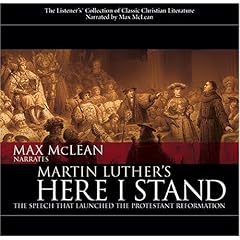
Martin Luther's Here I Stand: The Speech That Launched the Protestant Reformation (Audio CD)
1. Introduction
Monday, January 8, 2007
Martin Luther's Basic Theological Writings


