
 This book comes out well before Easter to make sure that you are able to buy it, study it and then teach its truths to others as Easter comes about. The book is laid out to have 25 short teachings and thoughts on the cross of Christ. It has most theologians that you can think of in the Reformed and Calvinistic circles and then also includes at least one I know that wasn't a Calvinist (Adrian Rogers). Most of the chapters are about 3 to 4 pages which include many different angles to look at the cross. The topics range from Christ's humility in Gethsemane, silence among his accusers, our sin putting him on the cross, propitiation, forsaken by God, etc. I am not going to list every theologian and every topic, but I will say that this book is a very good one to help someone as they study further on the cross of Christ. This book is a book of quotable thoughts for any pastor.
Some of my favorites were Martin Luther, C.J. Mahaney, Tim Keller, Adrian Rogers and Augustine. Martin Luther is first up in the book, and in my opinion, it didn't get any better than Luther. I really enjoyed his chapter and found myself continually reading because of his start of the understanding of the "True Contemplation of the Cross." Here is an excerpt from Luther's chapter:
Take this to heart and doubt not that you are the one who killed Christ. Your sins certainly did, and when you see the nails driven through his hands, be sure that you are pounding, and when the thorns pierce his brow, know that they are your evil thoughts. Consider that if one thorn pierced Christ you deserve one hundred thousand.
The whole value of the meditation of the suffering of Christ lies in this, that man should come to the knowledge of himself and sink and tremble. If you are so hardened that you do not tremble, then you have reason to tremble. Pray to God that he may soften your heart and make fruitful your meditation upon the suffering of Christ, for we ourselves are incapable of proper reflection unless God instills it.
But if one does meditate rightly on the suffering of Christ for a day, an hour, or even a quarter of an hour, this we may confidently say is better than a whole year of fasting, days of psalm singing, yes, than even one hundred masses, because this reflection changes the whole man and makes him new…
Martin Luther, p. 12 (taken from Martin Luther's Easter Book)
Although there were some that stood out, there were also some where I couldn't wait to read and they seemed to fall a little flat. Not only tha, there were some that were just plain bizarre where I will either need to study further or just glaze over for the sake of the other chapters. The odd ones were John MacArthur's take on Christ's forgiveness on the cross. He believes that Christ was only asking for the forgiveness of those who would end up believing in Him and not everyone that was at the cross crucifying him. I believe he ends up making his theology read into this part of Scripture a little too much. The other two that I will have to study a little further were J.I. Packer's on Christ descending to hell and also Joseph "Skip" Ryan's chapter on Christ being thirsty. He takes this to mean that Christ was spiritually thirsty and not physically. My first take is that he is trying to stretch this text further than it allows.
Even with these three, the other 22 chapters far outweigh them to keep me from recommending this book. I would recommend this to any who would like a good understanding of the cross from a wide set of generations, convictions and theologians. Just know, that it doesn't get better than Luther's chapter, but that doesn't mean the rest of the book gets "worse." Highly Recommended
Buy the book:
Crossway
Westminster Books
Tuesday, February 17, 2009
Jesus, Keep Me Near the Cross
Tuesday, September 9, 2008
The Future of Justification
 This book is a tough one. The reason I say this is because I totally agree with John Piper's view, and the Reformation's view of the Pauline theology of justification by faith. I agree with Piper's and the Reformation's view of the imputation of Christ's righteousness to the believer. I also disagree with N.T. Wright's, which ultimately started with Schweitzer, Wrede and Sanders, view of Pauline theology and the link they believe it has with second century temple Judaism. Although I do like their premise of trying to understand Old Testament Judaism. I believe though that they get confused in what God intended with the Law and how the Jews misused it.
So, now that I have stated all that, you would expect me to really like Piper's book on the topic. The problem is that I think it is a little too early to try and refute what Wright is coming out and saying. The reason for this is because no one really has a clear understanding of what Wright believes (at least those who I have talked to). Piper even praises Wright for many of his views of Scripture, and also the high view that Wright places on Scripture. But, there are many places in here that Piper says that he "thinks" Wright means this, or that Wright "might" believe that. I would think that it would be better to go ahead and wait this out until we find what Wright is really saying before we try and refute him outright.
With all this said, I also understand why Piper desired to come out with a refutation. I just believe it was too soon. I believe he would have been better to come out with a short intro to some disturbing beliefs of Wright and then wright a polemic on the justification of God and the imputation of Christ. I know that Piper has a couple of books that do this, so maybe an update to those books with this intro would have served better.
The book, because of the confusion of Wright's beliefs, is very hard to follow. There are even parts in the book where I would probably either agree with what Wright is saying, confused on what the problem is, or just am completely confused on what Wright really believes. The book really makes you feel like Piper is as confused as you are with what Wright is trying to say.
I honestly wouuld not recommend this book to anyone trying to get a grasp on what Wright believes, it was very confusing. Because of this, Piper's refutations come out very confusing as well. The best part of the book was the end, when Piper gives a small defense of the imputation of the righteousness of Christ.
I believe that this book will be something that will be forgotten and will need to be thrown away once we understand more on what Wright is trying to get across in his views of Justification and Pauline theology. Once a better understanding is seen, I would ask Piper to try again. Not Recommended. Link to Buy.
The Legacy of Sovereign Joy
 This is the first of the series of "The Swans Are Not Silent." This series is a series of books that are quick bios on the the lives of different people in the history of Christendom. The reason for the title of this series comes from a quote from Eraclius. Piper tells us the following:
Monday, March 17, 2008
Fifty Reasons Why Jesus Came to Die
 This is a small book that is really a good "cliff notes" version of why Christ came to die. It is only 120 pages long and so the descriptions of each are no longer than a normal page each. Because of this, the material that Dr. Piper presents is not to get into a deep theological discussion on each topic, but merely to give a quick synopsis and then to move on. I think this would be a great small group study to have with people. It would give the basic understanding and then would lead to some discussion on each topic how this should impact our lives.
Piper, J. (2006). Fifty Reasons Why Jesus Came to Die (16). Wheaton, Ill.: Crossway Books.
Wednesday, March 12, 2008
God is the Gospel
 John Piper called this book his most important that he has ever written. With that in mind, I decided to read it. I have a lot of respect for this man in his preaching, his ecclesiology, his missiology and especially his overall orthopraxy. As I started to read the book though, I felt like it was beginning to be a little repetitive and really didn't know how Dr. Piper was going to fill up close to 200 pages on the subject. But, I started to feel like Matt Damon in Good Will Hunting when the character played by Robin Williams kept saying, "Will, it's not your fault" and Matt Damon's character, Will, kept saying, "I know." It took Will Hunting a while to get it, but he finally breaks down and understands what Williams character is trying to get across to him.
This is how I felt about this book. Dr. Piper keeps preaching that God is the Gospel until the reader gets it. This is probably why I really liked the latter part of the book, because I think I finally started to understand it in my heart and not just in my head. Because of this, the book is very well done.
The one quote that affected me the most though, came at the beginning, on page 15:
If you could have heaven, with no sickness, and with all the friends you ever had on earth, and all the food you ever liked, and all the leisure activities you ever enjoyed, and all the natural beauties you ever saw, all the physical pleasures you ever tasted, and no human conflict or any natural disasters, could you be satisfied with heaven, if Christ were not there?
This quote is the thesis by which the entire book is based. The main Scripture that is used over and over in the book is 2 Corinthians 4:4,6:
in whose case the god of this world has blinded the minds of the unbelieving so that they might not see the light of the gospel of the glory of Christ, who is the image of God.
For God, who said, "Light shall shine out of darkness," is the One who has shone in our hearts to give the Light of the knowledge of the glory of God in the face of Christ.
Dr. Piper uses these two main verses to show how understanding that God is the Gospel will affect all areas of your Christian walk. It will affect your prayers, the gifts that Christs gives you (both good and bad), evangelism, teaching, confirmation of the Spirit, etc.
This book ends up being extraordinary, when at first I found it to be kind of overemphasizing. What I didn't realize is that it wasn't the book that was overemphasizing, but it was myself who was UNDERemphasizing this great importance. Most of what we think of the gospel and of forgiveness and glorification, almost get us there, and Dr. Piper, based on Scripture, takes you the rest of the way. You will no doubt have to re-read some of the parts in the book to get the full understanding, but it is well worth it.
I highly recommmend this book to everyone. It will show you or at least confirm to you practically, what the Gospel is meant to be and that is that God is the Gospel.
The just died for the unjust so that he could bring us to God.
Link to Buy
Tuesday, October 16, 2007
Amazing Grace in the Life of William Wilberforce

Monday, April 23, 2007
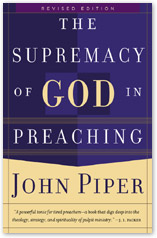
The Supremacy of God in Preaching
Sunday, December 31, 2006
Contending for Our All


