Tuesday, February 19, 2008

Vintage Jesus: Timeless Answers to Timely Questions

This book was definitely different than Mark's previous works. This was Mark's chance to just tell it how he sees it through the Word of God. In just 233 pages Mark and Gerry do their best to give the reader a better or a more refreshing look at who Jesus truly was, is, and is to come and how this should affect our lives.


The basic set up of the book is one of my favorites that I have ever seen. Mark answers a specific question to fill up each chapter (i.e. Is Jesus the Only God?) and then after answering the question, filled with biblical quotes and references, then goes on to answer common objections (usually 3 or 4 questions) at the end of each chapter (i.e. Does the Bible clearly say that Jesus is God?). This was very well thought out and done very well, to help engage the reader to what they might be thinking as possible objections to the original question posed in each chapter.

If you are used to Mark and his preaching this book will be nothing surprising or different than how he preaches every week. If you are not used to it, you might have some initial objections if you are "churchy" or might be surprised to hear such a down to earth approach to theology if you haven't grown up in church. But, I will tell you from experience, once you listen to what Mark has to say, he will allow you to see what Christ's mission truly was and continues to be in our daily lives.

Vintage Jesus tries to tackle a lot of subjects in a smaller book (233 pages), but does a great job of giving the reader something to grasp and look into further study without overloading them with content. I personally enjoyed the book and thought it was a good reminder and add on to Mark's preaching series that bears the same title.

This is a great book to give to someone who is unfamiliar with Jesus and is also filled with great material for those that have leaned too much on traditional views or legalistic ones of Christ. Mark brings every question back to the Word and challenges the readers to do the same.

The book is filled with humor and Mark really just "brings it" and because of this, like usual, he will have some haters that will say that he is a wolf in sheep's clothing. Which would make me laugh if they weren't so serious about it. I do laugh though everytime Mark describes these kinds of guys...cause I used to be one of them...Anyways...great book and look forward to the next title in October. Highly Recommended

Thursday, January 3, 2008

Spirit Empowered Preaching

Arturo Azurdia's book, Spirit Empowered Preaching, is one that you can tell is written by one that is both learned and learning this thesis that he has set forth. This I find to be something I enjoyed as I read. I have mixed feelings on the book, as I did like the information put forth, but felt as something was missing and yet I am not sure what it was.


What Dr. Azurdia's book is centered around is really the operation of the Spirit in the life of the pastor and in the Spirit's role when pointing to Christ. Dr. Azurdia shows this in many ways, whether it is through the prayer of the preacher to preaching Christ in the Old Testament. One of my favorite aspects of the book is the continual reliance on quotes from other notable pastors and their thoughts on the different subjects that were brought up.

In the end, I think the reason that I felt like it came up a little short is because I believe that Dr. Azurdia tried to cover too much, so when the reader was done with the book it is like getting nailed with a fire hose. I might just think that it came up short because it was more theology than practice, so I was waiting for Dr. Azurdia to say, "here is what I do." But, it didn't come to that. I could also be taking this from too much of an elementary look at this book and not at a book where its intent is not application or orthopraxy but merely orthodoxy. Nevertheless, I believe the strongest part of the book was when he set forth the ministry of the Spirit and why He is here for us. I strongly encourage reading the book for that alone. Either way, I felt like the book could have really used some practical thoughts on the subjects set forth.

There are some great reminders in the book, and it isn't that I wouldn't recommend the book, but I just found myself ready for more, but it never came. I strongly recommend to listen to Dr. Azurdia's preaching because the application of this book is found in his preaching, I just wish he could have put that down in words. If one wants a great practical book on this same matter I would encourage one to take a look at "Preaching that Changes Lives."

Don't skip this book on this review though, pick it up and glean from this great pastor, his thoughts on preaching and the Spirit, and you will definitely get great things out of it. Recommended. Link to Buy


Wednesday, December 19, 2007

Instrument's in the Redeemer's Hands

I was given this book by a mentor of mine and told that it would be extremely helpful. The problem is that I saw it was deemed a "counseling" book on the back, so I moved on for a while before I picked it up and read it. I continued to see the book on the "Best Seller's" list at many sites that I admire, so I finally picked the book up and started to read. I have to be honest, if I were to try and write all that I learned this review would turn into a novel itself.

Paul David Tripp really unpacks a three part effort.

One: To show me who I am
Two: Who others are
Three: How to practically minister to them, and accept their ministering to me

This book gets to the root of the issues and he even starts with the theological impact of understanding who God is and then who we are, namely: we aren't perfect, we need change, and we need help in that changing process from Christ and others.

This book not only unfolds what we are to do in daily ministering opportunities, but he unpacks the practical ways to do them. One of my favorite quotes in the book is that:

We often say we need to preach the Word, but we also need to counsel the Word

That is what this book is all about. It is how to counsel the Word of God to those in everyday life that need change just like you and I. What will hinder this book is that some will think it is only for the pastor or counselor, but it's intention is for all believers and it is written that way and is desperately needed for today's church.

I have already used the book and will continue to go back to it to try and unpack my shortcomings and also to help others do the same when they are in need of ministering. I know this is not the "hot topic" of discussion around the water cooler, but this book is much more needed in today's world that wants to only deal with actions instead of the root of those actions, namely, our darkened heart in need of the power of Christ. You will learn how to effectively and biblically (synonymous terms) counsel another as they ask a simple question or are having everyday life problems, instead of giving a "pat" answer or reciting Scripture and telling them to pray about it. I cannot recommend this book more highly.


For Us and Our Salvation: The Doctrine of Christ in the Early Church

Stephen J. Nichols hit a homerun in this book. As the title suggests, Dr. Nichols' goal is to establish what the early church thought of the Deity of Christ. He lays this out by going through a quick examination of who the "players" are, what and who they were fighting, and then laying out their arguments.

After this, he lets the men speak for themselves with their own writings. I really enjoyed this format. You get some explanation and then you get to read for yourself. Most books will either focus on just the explanation and yet others just lay out the entirety of a writing. This book is a great medium. Although it is short, it gets to the point and shows that the Council of Nicaea was definitely not the first time that Jesus' deity was brought forth in the church, but was orthodoxy handed down from the Apostles to those in the early church.

The book is broken down in chapters based on the different centuries and includes many men and their beliefs, from the early centuries all the way to the fifth century. You read from men like Ignatius, Irenaeus, Turtullian, Hippolytus, Athanasius, Leo the Great, and more. You also encounter some of the heretical writings so that you see what these men were fighting against.

All and all, I would use this book as a resource for any that doubt the doctrine of Christ's divinity in relation to the early church. No doubt the Bible speaks of the divinity of Christ, but now we are getting attacked that it was a foreign concept to the church fathers. This book puts that to rest in a quick and easy read on the subject that Jesus Christ was no doubt God, and was For Us and Our Salvation. Highly Recommended.


Link to Buy

Saturday, November 10, 2007

The Reformation: How a Monk and a Mallet Changed the World

Stephen J. Nichols has been coming out with a lot of books lately and has been highly recommended by a lot of people that I respect. I decided to take a look at a couple of his books and this one in particular, being that I am always looking for more information on the Reformation.

Nichols sets this up for an introduction for the differing reformations that happened all over the globe after the way that was paved by Wycliffe and Hus and then finally with the most powerful Martin Luther.

You can actually get a great understanding of where the book will lead you by seeing the different chapter titles.

1. Five Hundred Years Old and Still Going Strong: Why the Reformation Matters Today

2. A Monk and a Mallet: Martin Luther and the German Reformation

3. Some Middle-Aged Men and a Sausage Supper: Ulrich Zwingli and the Swiss Reformation

4. The Not-So-Radical Radical Reformers: The Anabaptists and the Reformation

5. An Overnight Stay in Geneva: John Calvin and the Swiss Reformation

6. A King and a Divorce: The Anglicans and the British Reformation

7. Men in Black: The Puritans and the British Reformation

8. Women in Black Too: The Untold Story of Women and the Reformation


Appendix: In Their Own Words: Selections from Documents of the Reformation

So, as you can see Nichols tries to cover a lot of ground in one little book, as the book, including the appendix is only 150 pages. It is very short in a lot of areas but it has to be so that the reader that is not accustomed to the Reformation can get their pallet wet enough to want to read other works that get more detailed each of these particular reformation periods.

The one thing that was stated at the first of the book that I was excited to see more about, that I found lacking, came when Nichols said we need to "humanize" the people of history. Meaning, we need to show who they were and not merely what they did. I felt as though Nichols did a pretty good job in this with Luther, but felt that this dropped off in the future chapters with the others. This, by no means, makes this book a disappointment and would definitely recommend it to others for an introduction to who and what went before us.

Nichols does make this history very readable and interesting to read without merely spitting out facts, which is happening in another book I am reading on the same subject. The book flows very well and makes you want to learn more about the reformers, instead of seeing history as a dry and dead subject.

I look forward to reading more books by Nichols and would defnitely recommend this to any who need an introduction to the Reformation from Wycliffe to the Puritans.

Link to Buy

Friday, October 26, 2007

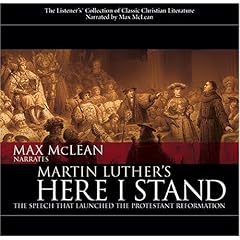
Martin Luther's Here I Stand: The Speech That Launched the Protestant Reformation (Audio CD)


This is a pretty cool little audio book. Max McLean is the narrator and this is the least that he does. He presents the material in a very well done manner. He does more than just recite, he gives the impression that it is how Luther would have presented the speech if he were here today recounting this pivotal time.
Track Listing:
1. Introduction
2. The Road to Reformation
3. Luther’s Prayer
4. Here I Stand
5. Eck’s Response to Luther
6. Luther’s Final Response
7. Conclusion
8. Sources and closing comments

The CD starts off by giving some background to what is taking place, in not only the Roman Catholic church, but also in Luther's life. The leading up to the speech takes about 11 minutes, which not only covers the aforementioned material but also the prayer that Luther recited the night before he was to stand and defend his new found understanding of Scripture. Then the time comes to recite the speech that Martin Luther brought forth at the Diet of Worms as he began what we now see as one of the most pivotal times in all of church history.

McLean presents the entirety of not only the speech but even the questioning of Johann Eck, which is when Luther's famous words that ring so true to rebut the questioning being presented was brought forth:

My conscience is captive to the Word of God, I will not recant anything, for to go against conscience is neither honest nor safe. Here I stand, I cannot do otherwise. God help me. Amen.

I would highly recommend this audio book. The speech itself is very emotional to read, but to listen to it with such passion from Mr. McLean is something that I will enjoy for a long time. Link to buy

Thursday, October 25, 2007

Blue Like Jazz

I entered into reading this book with a lot of opinions thrown to me from those who have read it. What I learned before I even opened the book is it seemed as though people either loved it or hated it. I have some really close friends who loved the book and thought it was a breath of fresh air, and I also knew some of my friends thought that it's only good was to start a fire with it.

So, because I trusted on both sides, I felt like I could come with no preconceived notions. It was like I heard each debater by themselves but couldn't make a decision until I heard them both at the same time. So, the only way to do this was to read the book. What kind of irritates me is that I landed right in the middle. I can see why people love the book, but I can also see why people hate the book. There are some great discussions in the book but some very bad views on some theology that I feel could hurt those not driven by the word of God for discernment.

Donald Miller is a writer and a poet first, you can see that from the title of the book and in the opening pages. I like poetry when I am reading a poem but find poetry to be distracting when I am trying to read a book. What Mr. Miller does in this writing, in my estimation (although I am no expert) is try and use his poetry skills too much at times as one navigates through his story of redemption. It just isn't for me, that is, his way of writing. But I can get through that, not enough for me to put it down.

The book is really Donald Miller's testimony. It is his writings of how he came to know Christ and how he has grown in Christ, for this it is hard to say, "it is good" or "it is bad." At times, Mr. Miller seems to be scattered in thought and goes from one topic to another without leading the reader to where he is going. But, it is a testimony of what Christ has done for him, and that is much to sing praises about. Miller's book also punches some evangelicals right in the face with some realities of what is going on in today's conservative circles and it sickens not only Mr. Miller, but also myself. I have to say I felt it was worth the read to get a fresh perspective of contemporary Christendom. Mr. Miller brings up a lot of good points, like feeding the homeless, caring for the homosexual and liberals, and loving people yet still telling them the truth of the Gospel. This love, Mr. Miller finds to be happening more in the "pagan" circles than inside the church of the living God and I have to agree. Mr. Miller though does not point fingers but he actually comes to the conclusion that it is HIS fault for this not happening and then asks all who read to understand that it is also their fault for this contemporary slide of hate instead of love for those outside of the body of Christ. I have to say, I like that perspective. Mr. Miller is very honest with his afflictions as a non-believer and a new-believer and I know this makes many people very uncomfortable. But for me, I enjoy when I can be honest with someone and they can be honest with me. It actually helps in prayer to know specifics of someone so that you can be praying for them. This is what Mr. Miller gives us in this novel of his life: An honest testimony of what Christ has done.

What I found to be dangerous are his thoughts on depravity and the atonement of Jesus Christ. He simply says that since he sees people doing good, then he doesn't believe that people are completely evil like some (one of them being me) say. I would have to ask Mr. Miller to trust in the Living Word instead of his eyes. I would ask him to interpret many Scriptures that would point him in the opposite direction, such as: Isaiah 64:6; Jeremiah 17:9; Genesis 6:5;8:21; Romans 3:10-18; Psalm 14; Jeremiah 13:23; Psalm 58:3.
He carries this thought though and it becomes disconnected as he then states the issues of us, including himself, being evil. So his description throughout the book of Christ's atonement and death on the cross becomes one that is to make evil people good. It is a moralistic redemption. This is not the reason Jesus died for our sins, He died to make dead people alive to God. He died to bring His children to His side for God's glory not ours. One of the fruits of a Christian is definitely to do good works and so this is definitely one of the benefits, but is not the primary reason for the atonement. So, this, in my estimation, is a very large error that Mr. Miller makes.
It seems as though Mr. Miller also relies much more on his experience than the unchanging word of God. I don't know this to be true, but this is the way it comes off in my reading of his book. This can be very dangerous, especially in light of knowing our heart is desperately sick, who can discern it...Jeremiah 17:9.

Also, his last chapter on "How to Love Yourself" is a little strong in parts. I do understand that his intent is to understand that God loves us and we need to accept that. I will be careful to say that this is probably a very good chapter, in parts, for those who have had terrible parents or disastrous intamacy issues for whatever horrific reasons, that I cannot empathize with since I myself have never had these kinds of experiences. But there are times in this chapter that go too far in my estimation. The Bible tells us to "die to self" "to deny self" and for what reason? So that we can "live to Christ" and to "follow Christ." So the author would have done better, in my estimation, to balance these understandings.

My recommendation to any who are thinking of picking up this book is to be discerning. I compare it with someone telling their testimony before they are baptized. The story of conversion is wonderful to hear. But, they say those two or three things that make you wince and say, "oohhh...wouldn't have said it that way..." But, that does not ruin the testimony of Christ in their life, and I don't think the errors in this book will ruin Mr. Miller's testimony either. I would recommend it for church leaders needing to understand what errors are creaping in the church as Mr. Miller points out. For the others, if you do read it, please be sure to be discerning when Mr. Miller brings theology and his experiences into the discussion, because I find it to be lacking in many ways. But, be challenged by his words when he calls us to be more loving to those who aren't like us and to understand that the issue is US not THEM. Link to buy

Friday, October 19, 2007

The Case for Faith

I want to show some grace here in this review so that I am not coming across as attacking the author or the participants that the author interviewed. I read The Case for Christ and very much enjoyed that book and thought it was done in a very tasteful manner, but this book left me shaking my head.


Lee Strobel unpacks this book just as he did with the Case for Christ, in that, he has 8 different questions that he would like answered and then goes and interviews 8 experts in those fields to answer those questions. The one thing I wish that he would have done is read some of the reviews and thoughts from readers and taken them to heart. The main complaint is that he just interviewed those who agreed with the Christian position and chose not to interact with those who were on the opposed side of the debate.
Although Strobel starts the book off on interviewing an atheist, Charles Templeton, this was the last time that he interviews anyone on the opposing side. Although, I do really like the way the book is set up with the interviewing process.

The questions that were to be raised in the book are the following:

1) If there's a loving God, why does this pain-wracked world groan under so much suffering and evil?


2) If the miracles of God contradict science, then how can any rational person believe that they're true?


3) If God is morally pure, how can he sanction the slaughter of innocent children as the Old Testament says he did?


4) If God cares about the people he created, how could he consign so many of them to an eternity of torture in hell just because they didn't believe the right things about him?


5) If Jesus is the only way to heaven, then what about the millions of people who have never heard of him?


6) If God really created the universe, why does the evidence of science compel so many to conclude that the unguided process of evolution accounts for life?


7) If God is the ultimate overseer of the church, why has it been rife with hypocrisy and brutality throughout the ages?


8) If I'm still plagued by doubts, then is it still possible to be a Christian?


Strobel, to answer these questions, goes to eight different men to help him answer these tough questions posed to the Christian faith. Some of those interviewed were Norman Geisler, William Lane Craig, Peter Kreeft, Ravi Zacharias, John Woodbridge and others.

We could always discuss the theological differences that I have between myself and the contributors, such as their views on libertarian free will, the views that hell is not a literal place with flames, the view that the big bang is true and God was the originator just 'tweaked' it to make it work, that God reacted to man and created hell, but it wasn't in His original plan, and so on. These are all things that contributed to a very poor discussion on the reason for faith. But, even above all these problems, Strobel forgets the biggest reason for faith in God and Jesus Christ: our sin.
Sin was completely left out of the discussion. This topic of us needing a Creator and Saviour to take our place of our sin was not in any of the discussions. The route that Strobel takes is more of a route in putting us in a court room. The atheists and agnostics as the prosecutors, God as the defendant and we are the jurors. We sit, listen, weigh the evidence and then choose who to follow. The problem is that this leaves God as a powerless being, ringing His hands, hoping we choose him. This is not faith! This is just choosing the lesser of the two evils, or the better of the two goods, depending on how you see it.

This book is really a bad attempt at presenting the true God. It really leans more towards Aristotlianism, where "reason governs us" instead of what we are told it should be: God and His word governs us. I am afraid that the bad theology presented here is not going to strengthen anyone's faith but in actuality, will make them rely on their intellect and thoughts on the issue. This is actually the reason that Strobel is able to bring in a Roman Catholic theologian (Peter Kreeft) and no have no issue with his thoughts on issues. Strobel really doesn't differentiate between the Catholics and Protestants but just merely continues to call them both "Christians." Ignoring the reformation or the Pope calling the Catholic church, "the only true church." (sidenote: I know this book was written before this declaration, but it was not a new declaration or something Protestants and Catholics didn't already know was the foundational thoughts of the Roman Catholic church)

Anyone who takes a long look at themselves will know that they change their minds on things all the time. They change their views on things all the time, so what is going to be different this time? The main proponent of faith was left out: Jesus Christ died for the sins of the people, the Holy Spirit gives them faith, calls them to His side, God justifies them with the blood of Christ, and perfects them until the day Christ returns. It is God's power that holds us, not our "weighing of evidence."
This is the reason I cannot recommend this book to anyone. It seems as though Strobel has placed God on the side of the road trying to "sell" His religion to people and hoping some will just choose Him. God is not a beggar.

One contributor said this: "God sends no one to heaven and He sends no one to hell" Although I agree that sin is what sends people to hell, it is not true that God doesn't send anyone to heaven. He is the only power that is able to send people to heaven.

It seems as though this book missed some key verses in the Bible:

For indeed He was crucified because of weakness, yet He lives because of the power of God. For we also are weak in Him, yet we will live with Him because of the power of God directed toward you.
2 Corinthians 13:4

No one can come to Me unless the Father who sent Me draws him; and I will raise him up on the last day.
John 6:44

Most important Paul lays out the importance of the Gospel, not secular reasoning or secular evidence for the case for faith:

For I determined to know nothing among you except Jesus Christ, and Him crucified. I was with you in weakness and in fear and in much trembling, and my message and my preaching were not in persuasive words of wisdom, but in demonstration of the Spirit and of power, so that your faith would not rest on the wisdom of men, but on the power of God.
1 Corinthians 2:2-5


Tuesday, October 16, 2007

The Deliberate Church

This is a great handbook for any preacher. It is seriously a handbook for the church. It gives great reminders and ideas for those that have been in a church for years and for those who have either just planted a church or that have taken over the reigns as lead pastor. Some of the greatest advice in the book focuses not only on the theological implications of the different methodologies in the church but in exactly how to implement different things in churches so that you don't scare off the sheep.


This book is amazing in its practical instruction on certain issues, even the particulars of how to run an elders meeting. So, it is truly designed for use throughout one's ministry and to be used almost as an encyclopedia of sorts of a "how to" for the local church. The book is broken up into four parts:

Part I: Gathering the Church
In general this section focuses on expository preaching, prayer, missions, membership and discipline

Part II: When the Church Gathers

This section focuses on worship and the regulative principle of worship, the ordinances, the role of the pastor, etc.

Part III: Gathering Elders

This section focuses on things such as the biblical mandate for elders, the searching for those men, staffing, etc.

Part IV: When the Elders Gather

This section is very practical and walks through how Dever's church handles elder meetings and the role of the lead pastor in those meetings. Very practical.

All in all this is a great book. I do not agree with every aspect of it, but those that I don't agree with I never felt as though Dever was "pushing his convictions" but was just putting them forth. This is great to see a man of God just showing the way their church do things without purporting it as the ONLY way, but A way. Very encouraging to see and more understanding of why Dever has been so successful in starting and maintaining the ministry of "Together for the Gospel" with others that don't see eye to eye with him on every aspect of the non-essentials.

I would very much like to see this book on the top of every list of books that pastors are ready and wanting to read. Very much needed book when the next great "how to grow your church no matter what" is probably just around another corner. Link to Buy

Amazing Grace in the Life of William Wilberforce

I am not a history buff by any means, so it was safe to know that I had no clue who William Wilberforce was. I picked up the book because I am sucker for both John Piper and biographies.


This book was intriguing being it is so small and wasn't in one of Piper's "Swan Biographies," and was on someone that I wasn't familiar with. I didn't know what to expect from a small biography, and to be honest, wasn't expecting much.

The biography really is just a mere introduction to the life of Wilberforce and his convictions. He was a young rich man in British Parliament that ended up, through a close friend, surrendering to Christ. After his conversion he was wondering whether politics was a calling or curse from God and was thinking of leaving his post in parliament. That all changed when he met with another pillar of the faith in John Newton on December 7th, 1785. Newton challenged him to stay within the confines of parliament to change it for the glory of God and Wilberforce did just that. He not only was the sole reason for the abolition of slave trade in Britain but he was also the reason behind the complete abolition of the practice of having slaves as well.
This small biography gives insight to the man and his mission to do all things to the glory of God. It is well intentioned and a great introduction to "tease the mind" to want to learn more of this man's convictions.

For this reason I would recommend the reading to anyone, but don't expect this to be a very deep biography or one that will give you all the ins and outs of the circumstances of the life of this defender of glory and righteousness. But, I also don't think that was Piper's intention, but his attention was to get the reader to be introduced to another dead man that stood for Christ, another man that we can imitate, as he imitated Christ. Link to Buy